Thursday, January 8, 2015

2014 fall paintings

I haven't shared my paintings from 2014, and wanted to share my nature inspired artwork with you. The beginning of 2014 was artistically/creatively consumed by my children's story project in which I wrote and illustrated a story about Silly dog.  You can check out a post about the  children's book here.  I painted over 20 pictures to illustrate the book.  After that project, I really didn't produce many paintings, but played with watercolors making bookmarks, and doodling.  Then summer came with summer camp and the garden and I didn't paint anything!  But after summer camp, I got busy.

I got a super pack of seven 1 ft square canvases because the first thing I painted after summer camp was series of paintings for John and Nicole for their wedding.  The three paintings are of horses that tell a nice story.  I painted the horses in a Native American style which I have always admired.  I fell in love with this earthy iron yellow color.  I would hang the paintings in this order horizontally with a 4 inch space between so the story doesn't get lost.  I always try to tell a story with my paintings.  I don't know if I always succeed, but I the idea of storytelling is important to me.

John and Nicole met while stationed in the Fort Hood 1st Cavalry horse division. They are part of the ceremonial and traditional detachment of mounted cavalry.  The detachment can be seen when troops are deployed from Fort Hood, when the commanders change posts, at parades, and other special events.  You can see a great photo of John in the Rose Bowl parade on the 1st Calvary Horse detachment facebook page  Way to go John!  Oh!, and the white/grey horse is suppose to be John's horse Sweet tea, and the Paint is Nicole's horse Breezy.  :)


The next painting was done for our landlords in Chaplin, John and Doreen Bolduc, who were exceptional.  My conversations with John often strayed to the deer that he feeds in his yard.  Jacob and I also had a tiny herd of two does and a fawn that would clean out the bird feeders every night.  They always froze and stared at me when they were caught in the act.  I enjoyed studying the woods as I walked to make the background look right.


Owl of the Year - Year of the Owl was the only painting that I really did for myself.  Seeing and hearing the Barred Owls in our backyard was a highlight of our year in Chaplin, CT.  Owls are so fantastic!


Lisa got a Red-tailed Hawk over looking the valley in McNeal, AZ for Christmas.  Red-tail Hawks can always be seen sitting on the telephone poles along hwy 181 that runs through the valley where she and my brother, Luke live.  The hawks seem to guard the valley.


Billie got Kangaroo Rats playing at night.  Billie is a veterinary assistant, and I knew she would love a painting of a  fuzzy animal.  I have also heard her describe herself as a desert rat so that's what she got.


I'd love to hear what you think!

Saturday, January 3, 2015

Favorite photos from 2014

My friend, Roberta, at Growing with Science, has posted her favorite insect photos from 2014!  Many bloggers, Arizona: beetles, bugs, birds and more, enjoy posting year end reviews, and I am no exception since starting my blog in 2012.  Here are links to previous year's favorite photos- 2012 & 2013

This year was a bit different since, I hardly took any photographs of insects!  In the past, my camera is pointed at lots of the six-legged creatures, but this year in Connecticut the focus was on plants, fungi, amphibians and summer campers.  I guess that is what happens when you are in a cooler climate instead of hot Austin.

Here are my favorite photos from 2014!  Happy New Year, Everybody!  I hope this is a great one for you all!  It's so hard to choose only a few pictures, but here are 14 for you to enjoy.


Amphibians- very orange wood frog, and a red-back salamander guarding eggs.


Mushrooms!
Tiny brown mushrooms photographed in a way that they look big.
A sunset colored amanita mushroom
with the tiny brown mushrooms to the left 


 The tastiest mushroom found in our yard, chicken-of-the-woods
A very New England view with birch tree, mushrooms, and woodpecker holes.

Snow-scapes- I had many more snow pictures from last winter, but I chose these two because I love how the sunset colored the snow and cast long shadows across the white and blue ground.


Plants!

Red Oak

Spring Ferns

Trout Lily

A few more favorites!
Jacob at the coast

Summer campers with Secret Oak, I love this picture.
The kids lined up on the tree as you see them.
This group was the first and most challenging of the entire summer!
I love the colors and action in this picture.
Cici's jumped into several of my pictures this year.
She is much more photogenic than my other two dogs.


Monday, December 29, 2014

Landing in a good spot


Shenandoah River State Park, Wildcat Ledge Trail overlooking the River (photo by Jacob Malcom)

We've made the move from northeastern Connecticut to Front Royal, Virginia.  There are many natural features that make this area appealing to naturalists like Jacob and me.  We have the Blue Ridge Mountains, with the Appalachian Trail passing through, and the Shenandoah River in our neighborhood.  The Skyline Drive of Shenandoah National Park, George Washington National Forest, Shenandoah River State Park, and more state and local parks offer thousands of acres accessible to the public.  Jacob and I learned how much we appreciate large areas of public lands like National Forests when we lived in Austin TX.  From Austin, it takes over 4 hours to drive to a National Forest, and the State Parks, while very nice, were few and relatively small for the number of people who use them.  After unpacking and Christmas festivities, Jacob and I have been out hiking everyday at Shenandoah River State Park, and Elizabeth Furnace in the George Washington Forest.  (More on these outings soon.)

Shenandoah River State Park, Shenandoah River along Bluebell Trail (photo by Jacob Malcom)

Shenandoah River State Park, Sycamore Tree (photo by Jacob Malcom)

Shenandoah River State Park, Shenandoah River along Bluebell Trail (photo by Jacob Malcom)


However, the spot that we are enjoying the most is the ten acres where we are living. Jacob's parents moved to the property more than 35 years ago, and Jacob's dad is a fantastic gardener and naturalist. The ten acres have many great trees, a stream, pond, old orchard field, and the gardens filled with both natives, and exotic plant species.  The wildlife abound in the shrubbery and varied habitats with numerous birds, chipmunk, squirrels, rabbits, foxes, deer, and in the Summer the bird feeders are often visited by black bears!  Ansel's garden are a testament to getting rid of boring lawns, and growing wildlife habitat.  Click here to check out a post I did a little over a year ago about Ansel's Garden.  We are very happy to be calling Virginia home with both Ansel and Mary Carol. I'm sure there will be lots of fun nature oriented things to blog about.

I hope you had a very Merry Christmas and a Happy New Year!


Thursday, December 11, 2014

Goodbye to friends

Yesterday, the dogs and I went out in a cool drizzle.  Two days ago, it was pouring cats and dogs, and we were indoor all day so we needed to get out.  We went out to one of my favorite spots, a pine groove that has a vernal pool.  It was a very nice walk with the rain making music on the newly filled pool. The drips were falling in big drops off the trees and it actually sounded like a bird or frog chirping.  I stood for a few minutes trying to figure out what was making the sound and then several more enjoying them.

Can you find Cici?  That's how big the tree was!


On the way home, I found that one of my landmarks, an old oak, was down!  I don't know when exactly the giant fell, but it was within the last month.  It wasn't cut, but looks like it finally lost it's balance as one side was rotten and it had already lost a tree sized limb some time ago.  I have often used that limb as a park bench in my woodland walkabouts.  The tree smashed several smaller trees, one a fairly large birch.  I think the white oak was at least 60 ft tall and 4 ft in diameter.  It would have been incredible to see the impact of its fall.  I think it is interesting to see the natural death of this 200+ year old tree.  Many trees do not reach such size and age, but succumb to insects, fungus blights, animals foraging, and the chainsaw.  I feel thankful to have been able to see the end of the long life cycle of the tree.  Not that I wanted the tree to fall, but that I got to see acorns, seedlings, small trees, mature specimens, and the end of such a wonderful type of tree, the White Oak.  The White Oak is Connecticut's state tree and a principle species in the New England woodlands, and this one was my woodland friend.

Tree standing with branch down in front last winter
(I know its not the best photo, I did say I have a hard time
photographing trees just a few posts ago.)
Cici and Silly on the limb last winter.

The trunk of the downed tree.
Where's the dog this time.


It is also interesting that my discovery of the tree's end coincides with mine and Jacob's last week in New England.  We are moving down to Virginia where we will live with family for a time as we figure out where to go from there.  We have enjoyed living in the woodlands of eastern Connecticut, but Jacob has learned that academia is not the career route that he wants.  So one chapter ends, another opens, and I am excited to see what fun (without the stress of academics) comes our way.  I will continue to blog about nature, environmental education, art, and other fun things that come my way.


As we head down south, we are thankful for the past year in New England with it's seasons, creatures great and small, and of course the trees!   I am thankful for the Connecticut Audubon with Sarah, Mrs Fish, Paula, Patty, and all the kids who I got to play -I mean work- with.  I am thankful for Mr. and Mrs. Bolduc our friends and landlords and the home we enjoyed.  Thank you Mr. and Mrs. Russ, and Mr. Church for allowing me to explore their properties.  I am thankful for everyone at Chaplin Elementary who were very kind as I substitute taught through much of the year.  Thanks to Emma and Goodwin Friends at Goodwin State Forest for letting me teach some programs before finding regular work at Connecticut Audubon.  Thank you for a wonderful year, and if you're down in Virginia, give me a shout!

Add caption


Monday, December 1, 2014

A Fisher in the early morning snow.


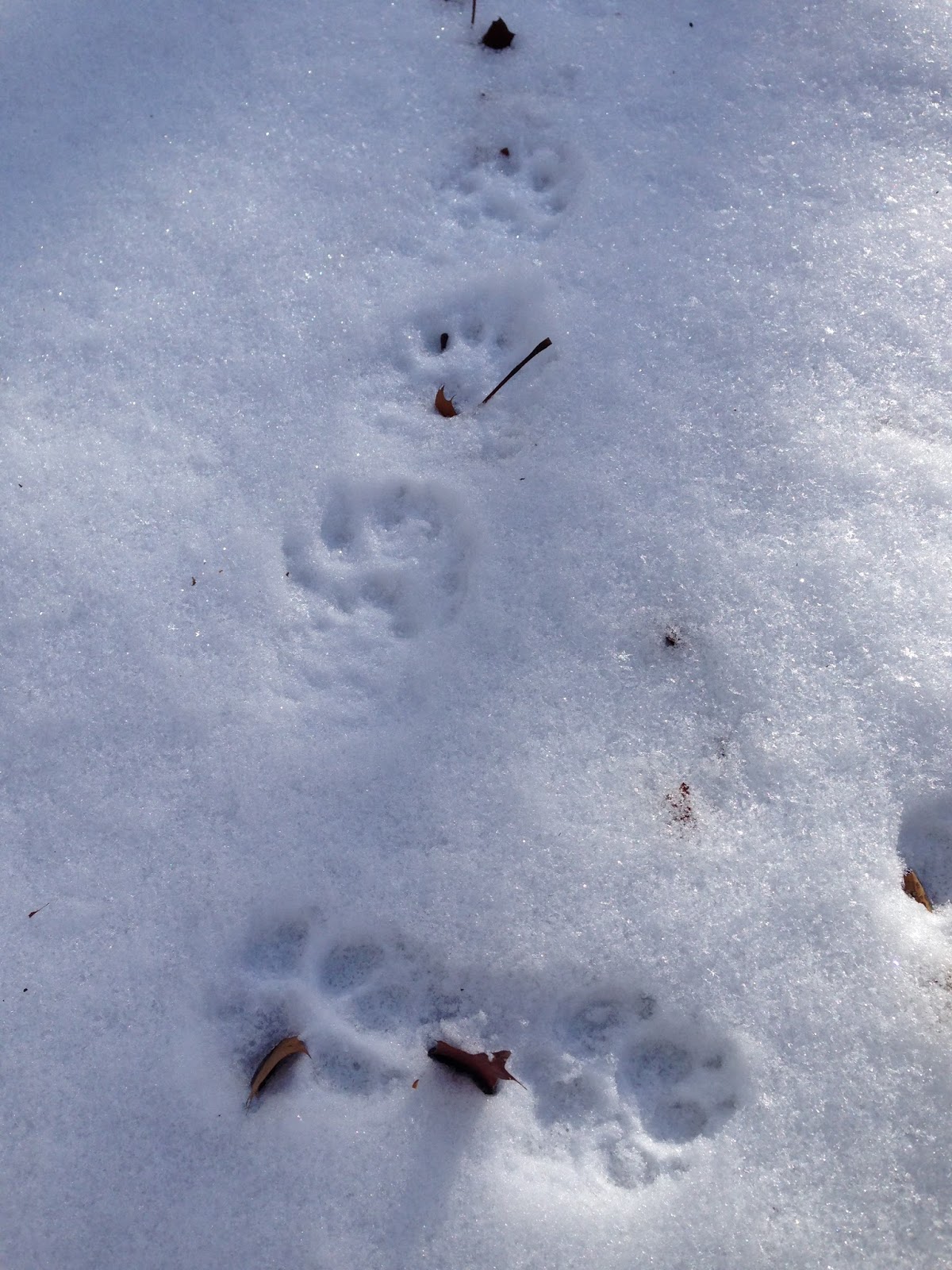
Fisher tracks in snow


Here is a good example of an unusual pattern that fishers
leave behind.  1,2,3,4 skip 1,2,3,4 skip  They can also make
a bounding pattern where all the tracks land together.
The day after Thanksgiving, I found signs of a exciting nighttime visitor, a fisher.  As I walked out back I found a trail from an animal with tracks that were as big as the tracks of my 45lb dog.  However, these tracks were not a dog's they wider and shorter than a typical dog track.  The tracks meandered all around circling trees, leaving a squiggly trail.  I saw where the fisher must have jumped to catch something, or just rolled around in the snow.  I confirmed my suspicions by looking up fisher tracks on the internet.  Fishers have 5 toes instead of 4 toes like a dog or cat.  Since they are long and short-legged, aka weasel shaped, they have different gates than a typical dog.  I saw both these traits in the set of prints left in snow.  


Fishers are one of the larger members of weasel or Mustelidae family, and is about the length of a red fox.  Connecticut is home to several Mustelidae including from smallest to largest: ermine, long tailed weasel, american mink, fisher, and northern river otter.  As you've probably noticed this mammal family has many members that are famous for thick fine fur needed for survival in cold northern winters. 


Fisher tracks going up the photo, dog tracks going horizontal.
See how wide and short the fisher tracks
are compared to the round dog tracks.
The dogs also have 4 large toes and the fisher has 5 small toes.  

A fisher in snow, cute isn't it, but not if you are a chicken, or a squirrel.
ForestWander
 - http://www.forestwander.com/2011/01/fisher-face-snow/ CC-BY-SA
Fishers, also called fisher cats, are oddly named because of all the things they eat, fish is not one of them.  I'm told fishers eat a lot of squirrels since they can climb trees with retractable cat-claws. Fishers, once very rare, have come back to Connecticut as the state's forests have regrown as farming has decreased.  The other day I saw something that I wanted to turn into a fisher, but chalked it up to just a house cat.  But it seemed long, bounded just a little oddly, and made me pause.  Perhaps, it was after all a fisher.  I want to believe it was.

Another fun note:
I contributed this week's mystery seed challenge to Growing with Science. I follow Roberta's Blog with her weekly seed and insect challenges, children's science and nature book reviews, and other enjoyable posts.  If you'd like to make a guess at the mystery seed check out Growing with Science.
(here is the answer to the mystery seed)

Happy belated Thanksgiving everybody!

Monday, November 24, 2014

Land of Grand Trees!


Connecticut is a land of grand trees!  The hardwood forest is tall and thick, strong and bending, and colorful and dark.  There are oaks, birch, hickory, maple, pines, hemlock, ash, cottonwood among others, each with their own texture, form, and place.  They can be a wall; hiding the lay of the land, make distances greater, and muffle sounds.  They can be individual with great presence, keeping the secrets of a centenarian.  The trees are so beautiful!  I love walking among them, recognizing both species and individuals, quieting my thoughts and just drinking in the peacefulness they offer.


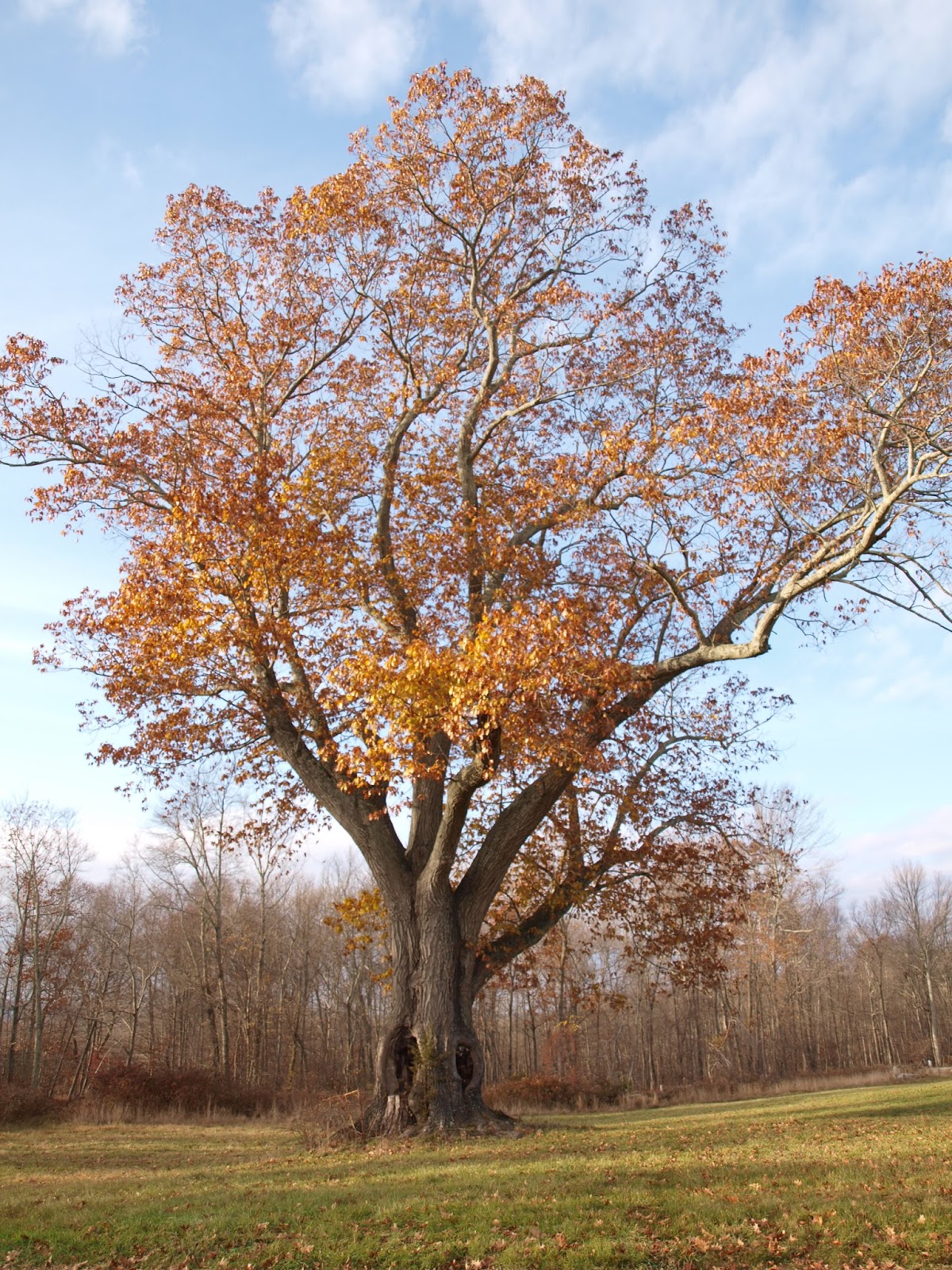
There are many trees that I admire growing in my neighborhood.  The Red Oak above is listed on the Notable Trees of Connecticut. It is less than a mile from my house on Juniper Hill Farm.  I could see it from the road and even though it was a little weird I asked permission to photograph it.  Such an amazing tree.  The Red Oak is one of the last to loose it's leaves.  The top picture is in November and the bottom in October.  Another fantastic Red Oak within 10 miles is the famous Ashford Oak.  It was the largest Red Oak in the US for years, but sadly it has dropped some of it's limbs and now is in decline.  The tree is just off the route 44, which is the oldest hwy between Boston and Hartford and George Washington really could have stopped here!  But really the best trees are the ones I can walk to, that are landmarks, friends, and make the area around the house so special.


The Ashford Oak


 A stately Maple in the woods near the house.  I've notice the largest trees seem to be the ones that are growing along old stonewalls.  That's because in the olden days, the fields would have been cleared for growing crops and only trees along the stonewall would have survived so they are the biggest and oldest.


I have found photographing trees to be a challenge!  It is hard to show what you eyes drink in.  A close up picture shows the texture and over arching branches, but loses the height and feels awkward. Far away the tree seems smaller, is shaded the tree's own shadow, or is lost among the trees.  To show the texture and size and light and presence makes me admire landscape and nature photographers who succeed.  I do admit that I don't practice enough with three dogs towing me along bringing my clunky camera along doesn't always happen.  Still the trees are wonderful.  I've written a few other posts where trees of Connecticut play a big role and here is one of my favorites, Rambles.

An interesting side note:  this is a bearing tree
One that can help you get your bearings!
In AZ officials place a stake in the ground with longitude and latitude information.
In CT, they place it on a large tree, because a stake would soon be lost under leaves and vegetation. 


Thursday, November 20, 2014

Time Travel at Benton Homestead


Welcome to the Benton Homestead (c.1720) in Tolland, CT!  This farmhouse was built by Daniel Benton on a 40 acre homestead, and six generations of the family lived in it.  The house is now a museum of life in the 1700s.  The house was little changed from it's original design, and the paint colors, kitchen hearth, and other portions have been restored by the Tolland Historical Society.  The house is the oldest remaining building in Tolland which will celebrate it's 300th anniversary next year!   

I was invited to help out during a school field trip by my friend Felicia who is a member of the Tolland Historical Society and fellow Audubon program teacher.  I jumped at the chance to assist and learn more about Colonial life. Growing up in Arizona did not afford many opportunities to experience Colonial history in such a hands on, and real way.  Plus, I got to dress up in fun costumes!  

Touring the house we presented what life would have been life for children growing up during the 1700s.  We talked about the chores boys and girls would have had, and what they would have been learning.  The kids learned that life was full of hard work necessary to have the food, clothing, and warmth to survive.  

Our first stop on our tour was the well, here each student got to try carrying two buckets of water using a yolk.  The kids learned that boys would be responsible for bringing inside about 15 gallons of water each day, plus many, many trips of firewood before they headed to the fields to tend animals, crops, chop firewood, or build those famous New England stonewalls.     


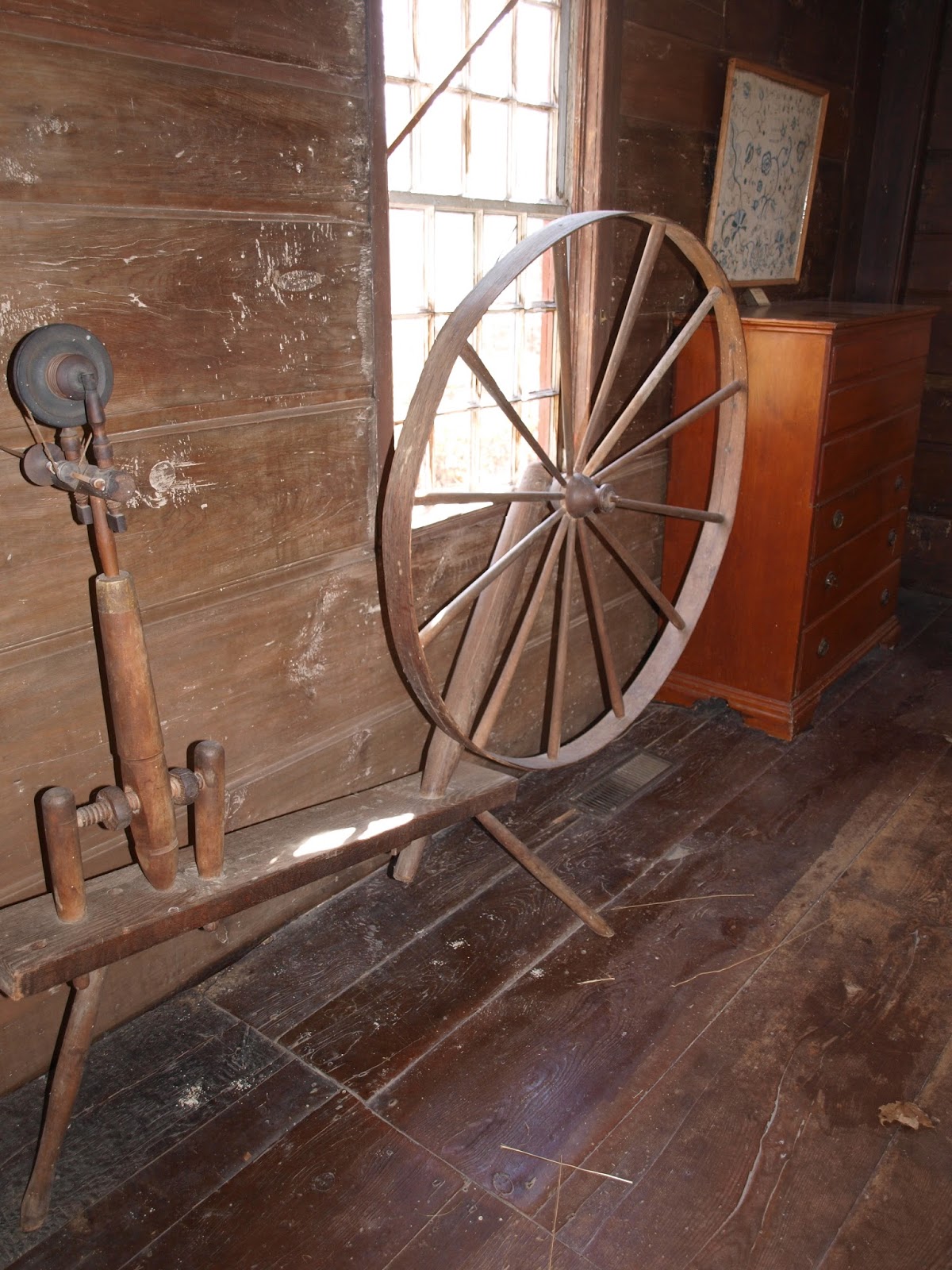
The first room we entered in the house was the Hall, named after the main room in an English castle.  This room displayed the tools used in converting raw fiber materials into cloth.  The kids learned about the processes for both flax-linen and sheep's wool. They got to card some wool, feel the raw materials, and see finished products.  Girls learned that they would start learning to sew at the age of 4, and would be experts by the time they were 13.  In the 1700s each family would have about a dozen sheep each giving about 10 pounds of wool.  The wool would have to be boiled and washed, carded, spun into string, and woven into material.  The material would then be sewn into skirts, shirts and other clothing or used as a blanket.  After spending 15 minutes in that room everyone had a better appreciation for our clothes and how easy it is for us to get them.  
A spinning wheel for making wool string.

Each room had a fire place, but the house would
have still be very cold compared to today's standards.
Fibers on the table in different stages of processing.
We also toured the kitchen, parlor, the in-law addition called the Ell, the cellar, and the kitchen garden. In each space the kids got to learn how things were different and the same, and how the rooms and places were used.   In the kitchen the kids got to see how different things were without electricity. They learned that the parlor was an adults only space, the cellar was used as a jail during the revolutionary war, and the Ell was built over the old well with a trapdoor for indoor plumbing! 

The kids and I learned lots about colonial times, had a fun time, and were all thankful to be living with modern conveniences!    


The Kitchen

Gail, the director of the museum, prepares the kitchen for students.


The wash bin on the left was used for cleaning everything.
dishes, clothes, and a bathtub
Gail in the kitchen with a beautiful cape.
She has a very authentic costume.

The parlor- adults only! room.  

a reproduction letter from Daniel Benton, colored glasses, and writing desk.

The Ell

Felicia in the Ell.  The trapdoor to the well is just under the table.

Artifacts found under the floor during restoration.  The Ell was added on to where the original backdoor was.  All the trash thrown out the back was preserved under the floor of the addition.  Ceramics, animal bones, pieces of glass, buttons including one from a revolutionary soldiers uniform were found

The pantry in the Ell